
Crisil Ratings on Wednesday projected India's GDP growth at 6.8 per cent in the next fiscal and said the country will become an upper middle-income nation by 2031 with the economy doubling to $7 trillion. In its India Outlook report, Crisil said the Indian economy will take support from domestic structural reforms and cyclical levers and can retain -- perhaps even improve -- its growth prospects to become the third largest economy by 2031. "After a better-than-expected 7.6 per cent this fiscal, India's real GDP growth will likely moderate to 6.8 per cent in fiscal 2025," said the Crisil India Outlook report.

'... to see that young people are gainfully employed. After that, it will become very difficult as we will start ageing much more rapidly.' 'We have a huge proportion of Gen Z. After 2030, every year, we will start seeing a gradual shift towards a slightly older society.'
HDFC Bank reported a 5.55 per cent increase in consolidated net profit to Rs 20,700 crore for the September quarter, with incoming MD and CEO Anup Bagchi indicating a focus on strengthening the balance sheet and addressing retail vertical concerns post-merger.

AI-driven job disruption, rising debt, shrinking savings and a changing global economy are reshaping India's middle class. Saurabh Mukherjea discusses jobs, entrepreneurship, investing and the future of India's economic growth on THE REDIFF PODCAST.

'Your retirement corpus isn't just a big pile of cash for 'one day' -- it is the salary you pay yourself when you no longer want to go to work.'

'They are claiming that they are very good in governance. All governments do propaganda. This is the propaganda of the government that they are doing very well, in spite of all the troubles.'
'They are claiming that they are very good in governance. All governments do propaganda. This is the propaganda of the government that they are doing very well, in spite of all the troubles.'

India's para track and field athletes delivered a stellar performance at the Aichi-Nagoya Asian Para Games, securing six medals, including three gold, on the opening day of athletics competitions. Long jumper Nishad Kumar, javelin thrower Rinku Hooda, and visually impaired middle-distance runner Soumya each won gold in their respective events, contributing to India's strong start.

The question for the next 20 years is not whether India can become a $5 trillion or $10 trillion economy. Those are attractive targets, but the real question is whether India can create enough productive jobs, educate its children properly, make its cities liveable, and give hundreds of millions of people a substantially better life, asserts Ramesh Menon.

In essence, Tata Sons will continue to be a CIC, whether registered or unregistered. It will have to follow the 90:60 principle.
If it qualifies as belonging to the upper layer, public listing will be one of the regulatory requirements. However, if it qualifies as 'unregistered CIC', it will escape from prudential regulation, explains Tamal Bandyopadhyay.

The failure of the State when it directly affects our lives, through a corrupt exam system, has produced this current anger, points out Aakar Patel.
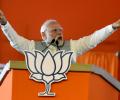
Prime Minister Narendra Modi's goal of making India a high-income economy by 2047 is unlikely to be achieved, but the country should become an upper middle-income nation by then, Financial Times chief economics commentator Martin Wolf said on Friday. Wolf further said that India would also become a superpower by 2047. "India wishes to become a high-income country by 2047.

India's electric passenger vehicle market saw an 87.4 per cent year-on-year increase in FY26, reaching 233,246 units, primarily driven by the mid-size SUV segment (20-30 lakh price bracket), while the entry-level segment (sub-10 lakh) experienced a decline.

There have been 41 cases of Covid in the most recent four-week period ending mid-January, with three deaths.

According to the World Bank, economic growth in middle-income countries, including India, is not accelerating. 'In fact, it is slowing down as incomes increase, with the trend becoming more pronounced each decade.'

'We are staying away from making forward-looking statements on when we will reach 1 trillion, etc. But growth will be rapid; it's only a matter of time.'
The country's per capita income is likely to grow by close to 70 per cent to $4,000 by fiscal 2030 from $2,450 in fiscal 2023, helping it become a middle-income economy with $6-trillion GDP, more than half of which will be coming in from household consumption, says a research report. Per capita income/GDP has risen from $460 in fiscal 2001 to $1,413 in fiscal 2011 and further to $2,150 in fiscal 2021. The biggest growth driver will be external trade which may nearly double to $2.1 trillion by 2030 from $1.2 trillion in fiscal 2023 when the GDP printed in at $3.5 trillion, Standard Chartered Bank said in a weekend report which assumes a 10 per cent nominal GDP growth annually from now on.
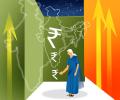
India no longer needs big ticket reforms but small and basic ones to drive the growth forward, Chief Economic Advisor V Anantha Nageswaran said on Monday. Addressing the media after the Economic Survey 2023-24 presented in Parliament, Nageswaran said there is a need to pursue all possible approaches without any ideological orientation. "In terms of the kind of reforms that we need to do, it is no longer big-ticket reforms that dominate your front pages but more about grunt works.

A recent World Bank report placing India among the most equal countries globally may present a limited view of inequality, with economists suggesting that broader data sets could tell a different story. According to the report, India's Gini index (or coefficient/ratio), a key measure of inequality, stood at 25.5 in 2022-23, placing the country fourth globally in terms of equality, behind only the Slovak Republic, Slovenia, and Belarus.
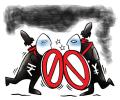
India and China have mostly set aside their bilateral differences in order to champion the cause of developing countries at the World Trade Organisation (WTO). That seems to be changing. During the latest round of China's trade policy review, India questioned its northern neighbour's claim that it was a developing country, since, going by the World Bank's definition, its per capita income belongs to that of an upper middle income country. "As per the per capita income level, the Chinese economy belongs to 'upper-middle income'. "How can China still claim to be a developing country? "What are the indicators which China is using to claim such a status?" India asked.

How much protein is needed for a healthy daily diet? A healthy adult needs a minimum of 0.80 gram of protein for every kilogramme of body weight per day. The average consumption of protein in India is around 62 gm per day, which is way lower than the global average of 78 gm.

Finance Minister Nirmala Sitharaman on Tuesday said the government plans to raise capital gains exemption limit on certain financial assets to Rs 1.25 lakh per year for middle and upper middle class.

Global Emerging Middle (GEM) is the next big market, says PwC. In India, this segment is expected to cross the USD 1 trillion threshold by 2021; globally the figure is expected to be in excess of USD 6 trillion by 2021.

'Don't look at Russia only as a place to earn quickly and then leave.' 'Try to build experience in serious companies, skills and certifications that will serve you anywhere in the world.'

There's no silver bullet to get rid of poverty, says Alok Sheel.
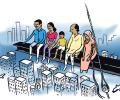
'For me, if I want to buy a house to stay, I don't care about indexation because I don't want to sell that house.' 'The only thing that matters to me as a buyer is that the home price should be within my reach.' 'Any market, when speculators and investors go out, it will benefit the middle class.'

'When the average growth in the last three years was just 2.5%, how does that make us the fastest growing country?' 'They only tell you what has happened in the last 2 years; they are not taking into account what happened in FY21 on account of their mistakes.'

BJP leader Subramanian Swamy on Sunday urged the Centre to do away with the system of collecting income tax and instead find out other means to raise money to the exchequer.

Even as India strives to climb the development mountain, the fact is that the mountaintop is already crowded. If it got there in 2047, India would be very much a late-comer, observes T N Ninan.

Ask rediffGURU and PF expert Nitin Narkhede your mutual fund and personal finance-related questions.
By 2030, China will exercise dominance while still being only an upper middle-income country.

It is not just the secondary market that is witnessing a revival in fortunes. Even the initial public offering (IPO) market have roared back to life, with investors submitting bids worth over Rs 2.2 trillion on the three IPOs that wrapped up on Friday. Fashion retailer Vishal Mega Mart (VMM)'s IPO (fifth largest of the year) garnered 27.3x subscription, with bids exceeding Rs 1.6 trillion.

Musheer Khan stroked a fluent 181 from 373 balls, while Navdeep Saini claimed 2/36 to give India B the upperhand on Day 2 of the Duleep Trophy match.

'Till the BJP does not understand Kejriwal they cannot win Delhi.'

Adani Ports, NTPC, Infosys, Hindustan Unilever, HCL Technologies and Sun Pharma were among the other big gainers. However, Larsen & Toubro, Bajaj Finance, State Bank of India, Axis Bank and HDFC Bank were amonh the major laggards.

There is mounting evidence that suggests that Omicron subvariants -BA.4 and BA.5 - are infecting people who have been vaccinated.

Be it poor, middle class, upper middle class or rich, every individual who is 70 years and above is eligible for getting Ayushman card and will receive free treatment up to Rs 5 lakh at any of the AB PMJAY empanelled hospitals once the expanded scheme gets launched.

After 2014, our growth has been average of around 5%. If this continues, we will remain here like Egypt, Brazil, South Africa and Bangladesh, points out Aakar Patel.

'Generating employment requires a shift in policy.' 'If not, the country will face economic, social and political challenges in the coming years.'
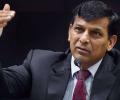
Indian economy, dubbed the fastest growing major economy in the world, is faced with the single most important pressure point of job creation, says former RBI Governor Raghuram G Ranjan as he makes a strong case for improvement of human capital through skill development. Talking about the book 'Breaking the mould: Reimagining India's economic future', written jointly by him and Rohit Lamba, assistant professor of economics at Pennsylvania State University, Rajan said one of the greatest strength of India is its human capital of 1.4 billion and the question is "how do you make it strong?" The nation needs to create jobs at every level going along the path of development, said Rajan, presently Katherine Dusak Miller Distinguished Service Professor of Finance at Chicago Booth, USA.
